Tuesday, October 12, 2010

You can call me 'Gringa'

The best part of my Guatemala trip so far has got to be the kids. As soon as they see me they start chanting, “Gringa, Gringa, Gringa!” and then they run over and swarm me with hugs.

Of course, after that they start blabbering away in Spanish and I have no idea what they are saying.

I try to tell them I don’t speak Spanish, but they don’t care. They keep asking “Gringa” questions, but all I hear is “Gringa, blah blah blah blah blah?”

So I bring out my camera to distract them. They hop up and down, shout a little cheer and start posing.

They LOVE getting their photos taken. Really, really, really love it.

I swear, I must have 50 photos of the group of little kids I found playing in this structure behind the hospital. They are hilarious. I have to take a photo and then show it to them. Then they all run over and look through the viewer.

Then, it’s “Gringa, photo, photo!”

Ha! Now they are speaking my language.


Guatemala Day 3: Watching a real-live operation

This little boy would let go of his dad.
The vibe on Monday was completely different from the day before. The team was focused on pre-op, surgeries and post-op and it felt like a real hospital. We were geared up and ready to work and there was no time to waste. We had planned to do 16 to 20 operations a day so the schedule was tight.

I got to wear my scrubs for the first time as I would be going into the operating room today. I thought I had picked out ones that would allow me to blend with the surgical team, but apparently I bought very fashion-forward ones (even though they were on sale) as everyone kept commenting on them. My scrubs even became the talk of the dental lab.

Oh well, I can't deny that I am a bit of a fashionista, but back to the mission.

As I walked down the hallway, every family I met looked apprehensive as they waited quietly for their surgery time, and some of the kids were hanging onto their parent’s legs, afraid of what was to come. They would still smile when I greeted them, but it faded quickly and was replaced with worry. However, they weren't the only ones apprehensive. Today would be the first day we would be working as a team and I wasn't the only one who would be in role that were far removed from what we did in back home.

Me in the operating room.
"I'm usually not in the operating room," said RN Mary Sanchez from South Carolina. "I work in intensive care so this is very different for me. I have to remember to stay clear of the sterile field and count the sponges. In intensive care, I know it so well, I can react automatically in an emergency situation. Here, it's not like that."

By 8 a.m. the first patients were being prepped in the pre-op room, but it turned out their wait was going to be a little longer than planned as all of the facets in the hospital were spewing out nothing by air.

Surprise! We had no water. Not even a drop.

“We can’t perform surgeries without water. We can’t scrub up before or wash our equipment,” Dr. Ray Maddox, our team leader said.

The team weighed our options. Should we postpone the surgeries? Should we use our limited drinking water for scrubbing? Finally, after much running around, the fire department came to our rescue and used their truck to fill up our tank. Apparently a tree had fallen and obstructed the flow of water between San Filippe and the hospital. They had to cut around the tree to free the stream.

We breathed a sigh of relief. We may have been behind schedule, but we were back to helping people.

RIGHT ON TRACK

The lack of water didn’t stop audiology from seeing their patients and they were quickly moving through their list. Each person who came in to see them had a story, including their oldest patient of the day.

Patient explaining that an animal went in his ear years ago.
“An animal went into my ear 30 years ago and, after that, I couldn’t hear,” said the 84-year-old man. “I was working at a coffee plantation at the time and it took them a long time to get it out."

He was adorable. If he heard the test beep loud and clear, he raised his hand high, but if it was quiet, he would show us the universal “little bit” sign using his thumb and forefinger.

Our CCCA, Jodi Bova, set him up with a hearing aid and you never saw a brighter smile. He thanked us over and over and gave everyone on the team a big hug.

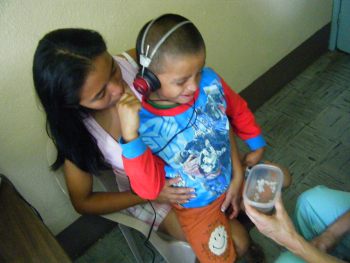
But not all stories had a happy ending. Five-year-old Angel was born premature and had never spoken. Because he couldn’t understand the instructions, our pastor Karen Prevatt taught him to put a plastic ball into a container every time he heard the sound.

At first we thought perhaps he was hearing something as there were times when Jodi would play the sound and he would drop the ball in the container. Each time, he would make a little proud smile. But our hope was soon dashed when we placed a hearing aid on him.

“Unfortunately, in this case the hearing aid showed no improved response. We didn’t think he would benefit from it,” Jodi said.

It’s always hard to give out bad news, but the team was able to provide the parents with some other options such as the number for the local deaf school. It wasn't much, but it gave the mother some hope for her son's future.

SAVED BY THE GLOVE AND THE UTERUS THAT GREW…AND GREW…AND GREW

Meanwhile, back in surgery another obstacle had crept up.

The glove that saved us.
In the United States, the camera lens used in laposcoptic surgeries such as gallbladders comes sterilized.

It turns out that’s not the case in Guatemala, and the surgeons didn’t feel comfortable having a non-sterilized piece of equipment on the operating table. Instead of risking contamination, they needed a solution – and they needed it quickly.

CRNA Christian Cleveland-Peck came to the rescue, pulling what we fondly refer to as a “McGyver” move.

“To keep everything sterile, he cut out the finger of a rubber glove and ran the lens through it,” said Dr. Cathy Sims. “It was so simple and it worked!”

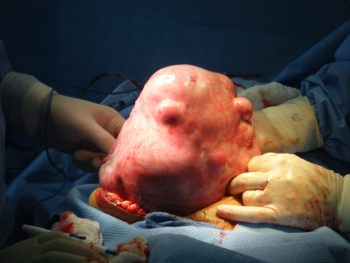
The 8 lb uterus the doctors removed. Amazing.
As the team quickly set up for their first surgery, over in Operating Room #1, Dr. Gordon Graham, Dr. Surendra Sharma, RN Pat Egerton and RN Mary Shanchez were busy pulling off their own brilliant moves. Their 39-year-old patient had come to the hospital with an enlarged uterus.

“I can’t believe the pain this woman must have been living in,” Mary said. “When he removes it, she will wake up feeling like a new person.”

Mary was right. This poor woman’s uterus had grown to the size of a small watermelon and she looked like she was 30 weeks pregnant. When removed, it weighed 8-pounds and had multiple tumors growing out of it.

“It’s one of the biggest ones I’ve removed,” said Gordon. “In the US, we would have most likely caught it much earlier so it wouldn’t have grown to such a massive size.”

It WAS the biggest one I had ever seen.  This was the first surgery I had ever witnessed and I found the whole experence amazing.  I swear, if I would have seen what I saw today when I was 17 and making career decisions, I would have been a surgeon.  I loved watching them work.

FROM DAWN TO DARK

Monday was the first of many long days. It began in the dark at 5:30 a.m. with devotion lead by Karen and continued long after the sun set. Some of us were able to get back to the hotel by 6:30 p.m., but a few members, including CRNFA Jennifer Curran in recovery, were there until 8:30 p.m. making sure all the patients spending the night were stabilized.

"One little boy asked me if I was going to stay and have a party with him. He was having so much fun at the hospital," said Jen.

All areas in the hospital were non-stop busy including the dental area where Dr. Christine Hoeplinger and a dentist from Guatemala were seeing 14 patients a day.

There was only so much they can do this week so Christine and her team are focused on cleanings, fluoride treatments, fillings and sealants.

“We don’t have all the equipment here to save the teeth. I’d love to be able to do other treatments, but I can't,” Christine said.

In total, we completed 18 surgeries on Monday. They included abdominal hysterectomies, vaginal hysterectomies, cystocele-rectocle repair, myomectomy, herniaplasty, laparoscoptic cholecystectomy, bilateral sphenoildatomy, removing tumors, frenulectomy and tonsillectomies.

These, along with the patients we met, became the talk of the day. We added them all to our list of miracles – including the massive uterus and the rubber glove. They may not be traditional miracles, but they certainly weren’t something you see every day.

Monday, October 11, 2010

Guatemala Day 2: Day of Triage

More than 150 people showed up at the hospital on Sunday to meet with the doctors. I wasn't sure when they arrived, but when we arrived at 7:30 a.m. they had already filled the waiting room and were lined up down the driveway and out onto the grass. But there was no pushing or chaos. Instead they waited patiently and greeted us with happy "Good mornings" in Spanish.

Seeing all these people and their expectant faces got me a little worried.  How in world were the 30 of us going to pull this off in this old hospital?  I didn't even know how helpful I was even going to be.  I didn't speak Spanish and had absolutely no medical skills, but here I was and these people were looking at me with such hope in their eyes.

It was going to be a busy day. The doctors would be scheduling 60 to 65 surgeries to complete over the next four days and our goal was meet all 150 patients who were waiting on Sunday. In addition to the triage, other people on the team were setting up the operating rooms, the pharmacy and the recovery areas.

Before going out, our team leader Dr. Ray Maddox gave some important advice.

“We are all practicing outside our comfort zone… in a third world county and in a different hospital,” said Ray. “We need to be flexible and roll with the punches.”

ONE BY ONE

The advice was well heeded. By 8:30 a.m., the air was already humid and the waiting room was starting to heat up from all the bodies. For those of you who have lived in Texas, imagine that humidity in a room filled with a hundred people. We were hot, hot, hot.

Then the triage began.

“Claudia Lopez!” called out the nurse.

The waiting Guatemalans shouted the name to those in the back of the room who relayed it out to those waiting on the grass, driveway and sidewalk. Before long, Claudia could be seen weaving her way through the crowd, and our work had officially begun.

My role was to help Dr. Gordon Graham in gynecology by escorting in the patients and trying to make the women feel comfortable during their exams. Our first patient of the day was Erika.

Speaking very little Spanish (really, I speak practically none), I couldn’t understand what they were saying, but I could understand the tears and the sadness as her mother explained her symptoms. Erika has been born with a tube around her uterus and had a half developed arm. She now had to go through another surgery and she was afraid.

“I don’t want to do a surgery, but I will do it,” said Erika.

As I led Erika and her mom to the anesthesiology department after the evaluation, I could tell they were a little shell-shocked. Erika would be undergoing her surgery the next day.

Our next patient was a 58-year-old woman with cancer, who greeted me with a kiss on the cheek (so cute that they do this even when meeting you the first time). After her evaluation Dr. Graham told her she would need abdominal hysterectomy.

“Can I take other medication instead?” Francesca asked.

Like Erika, she was scared and was hoping the doctor would recommend something easier. You can’t blame them for being frightened. Unlike in the US, where you may have a few weeks to prepare for surgery, some of them have only 24 hours. Plus, immediately after hearing the diagnosis, they have to decide whether or not they want to go through with it. If they decide no, they may have to wait months before they have the chance to see the doctor again – and by then it could be too late.

But there was another complication to Francesca’s case that the doctor couldn’t fix.


Ezmereld's mom burst into tears when we gave her bus fare to return.
 “We can do what we can for her here, but they may not be able to get her the radiation she needs after the treatment,” said Gordon. “We can only hope there is no microscopic spread.”

Many Guatemalans, like Francesca’s family are poor. While they know they need the medical help, they can’t afford the trip to the national hospital for the follow up.

Similar of heart-breaking stories were happening in general triage area where Dr. Richard Bland and Dr. Surendra Sharma were evaluating their patients. While many of the patients they had seen that day were hernia and gallbladder cases, Richard told me there was one unusual case -- the woman had a large mass that started under her armpit, encompassed her shoulder and was moving into the clavicle area.

“Sometimes there is nothing we can do here,” said Richard. “She had waited too long before seeing a doctor. All we can do is a biopsy to confirm the diagnosis.”

Other cases were less severe and there were times when the patients chose not to have the surgery at all. One 65-year-old man who had a hernia did just that. After speaking with the doctor, he decided his pain was minor compared to having to through a surgery. He opted to wait a few months to see if got worse.

TEARS, FEARS AND OTHER CASES

Over in EMT, Dr. Mark Hoeplinger, medical student Brad Oriel and RN Char Schumann were busy evaluating their cases.

“We had lots of tonsils, a few broken noses and one case where a little boy had a tumor on his cheek,” Char said.

They were also checking ears for possible hearing loss which seemed to be one of the common problems in the country.

“A lot of times, the people in Guatemala have some hearing loss caused by ear infections that weren’t treated. In some cases, the infection grows and the membrane ruptures,” said Char.

Char said another reason for the increased number of cases was that they have been using unpurified water to clean their ears. While they had good intentions and thought the water would get rid of the infection, the bacteria in the water, actually helped it grow.

But bad water was only one issue.

“We have seen a few people with cotton in their ears. Their ears were most likely hurting, so they put it in and left it there,” said Char. “In many cases, they just need to be educated on what they should do.”

There was one little girl that touched us all.

Her name was Ezmeralda and her family had traveled 80 km to see the doctor. Dr. Hoeplinger tried to clean out her ears in order to check her hearing, but she needed to come back a second day to complete the treatment. She was also malnurished as the family couldn't afford food.

“She’s had a lifelong ear problems and she’s currently draining pus so we want her to come back,” said Mark. “We can give her drops today and do the rest on Tuesday.”

Unfortunately, the family didn't have the 56 quetzals to return (roughly $7 USD). They had used all their money just to get there for today's appointment.

Touched by the little girl and the poverty problem of the her family, the doctor gave them the money. The girl’s mother burst into tears, thanking the group over and over. She hugged us all, and yes, I was holding back the tears.


For them, this little gesture of caring was a miracle.

CAN YOU HEAR ME NOW?

More miracles were happening in the audiology area, which was run by Jodi Bova, Susana Wilson and Karen Prevatt, our pastor. One of their patients was a 14-year-old girl. Her mother told us they first noticed she had a hearing problem when she was 6.

“She answered the phone and said no one was there, but her brother was on the line,” said the girl’s mother via Susana who was translating. “We told her brother to shout really loud and she still heard nothing.”

Jodi placed the headphones on the girl. Then we waited in silence for the girl to respond. We watched as she raised her arm to some of the sounds and did nothing through others. It turned out the girl had no usable hearing in her left ear, but the good news was she did have some hearing in her right ear – making her a good candidate for a hearing aid.

“This was good news. It’s very sad if we have to turn them away,” said Susana. “We had two out of the 16 we saw today where we couldn’t help .”

While helping everyone is rewarding, the audiology group did say they had one incredibly happy moment in the morning.

“We had a 2-year-old boy who had hearing loss. Because he couldn't hear the instructions, we came up with a way for him to test his hearing by putting a plastic piece into a container every time he heard the beep,” Jodi said.
They were able to fit him with a hearing aid and for the first time he was able to hear his mother’s voice.

We left the clinic around 6 p.m. feeling exhausted, but satisfied.

We now had our roster of patients. Tomorrow the surgeries will begin.

Sunday, October 10, 2010

Guatamala Day 1: A long day of travel, but worth it

We arrived in Guatemala City in shifts. When I say "we", I mean myself and 30 other people from across the US who had volunteered to work on a weeklong surgical mission in Guatemala.

I know it sounds crazy that I'm using my vacation to work in a third world country, but this was something I've always wanted to do, and finally the dream was coming true -  I was going down as the surgical team's historian.

Some of the team had come the day before, but many of us left on Friday night via the red eye and met at the airport on Saturday afternoon. After traveling so many hours and landing in new country, it was nice to see all green Faith in Practice t-shirts. Suddenly, I knew wasn't not alone.

But my day of traveling wasn’t over yet. My team still had to take the bus from Guatemala City to the hospital outside of Retalhulea. This would my glimpse of the country I’d be living in for the next seven days.

During the four hour ride, the group got to know each other. Nervous and not sure what to expect, there were a number of us who were first timers to Faith in Practice.

I was glad to hear this as I was worried I would be the only out of their comfort zone.  If you've ever met me, then you know that unless I'm working out or cycling, I'm not exactly the casual-go-without-makeup type. I'm a true city-girl.

But at least I wasn't the only one new.

“I’ve wanted to do this for five years, but there never seemed to be a good time to go,” said Karla, a RN from Portland. “Finally, I just decided to do it.”
Each of the new people had their own reason for joining Faith in Practice, and each had found out about it different ways.

“My physician had gone on the trip and told me about it,” said Susana from Northern California. “I’m a retired social worker and I wondered if there something I could do on the trip.”

There certainly was something that Susana could do. Being fluent in Spanish, she’s one our team’s translation people. She assisted the doctors as they triage patients.

While Susane and Karla were a few of the new people, others were Faith in Practice veterans, such as Maggie. She has been on 14 or 15 trips and this was her third time with a surgical team.

“The last time I was at this location was for a clinic trip. We had people lined up out the door and down the hill,” Maggie said.

OUR FIRST VIEW OF THE HOSPITAL

My team arrived in Retalhulea around 8 p.m. Even though I was hot and tired from traveling, I was still excited to see the hospital I would be working in.

The hospital was old and not at all like the hospitals in North America. It was going to take a little fixing up before we would be able to take in patients. The hospital contained 70 beds for the patients and one of our first jobs in the morning would be to transform the rooms into pre-op and post-op rooms in preparation for the upcoming week.
“We are all very happy you will be working with us this week at the hospital,” said Sergio Lopez, he hospital administrator.

The whole staff was happy to see us and it showed in their faces. Hugs were exchanged with those whose faces they recognized, while the rest of us were greeted with warm smiles.

“Welcome all the new ones and a double welcome to those who have come back,” said Dr. Cesar Joaquin Barrios, Director of the hospital.

In addition to the hospital building was also an area where people could stay if they had come from far away and needed a place to stay before and after their surgery.

“We have room for 30 to 40 people,” Lopez said. “And they can have with them one family member.”

The operating rooms were recently remodeled with the help of Faith in Practice. But the pride of the hospital had to be the brand new dental clinic which was also set up with the help of Faith in Practice.

It contained two dental chairs and could be used to do both evaluations and restorative dentistry. It is also air conditioned which was going to come in handy – they expected 100 patients on Sunday from a nearby school.

I looked around and knew we had a lot of work set out for us in the next week. But the team was ready to take on anything. And how could we not be?

The people were so gracious and so glad that we had come. Their smiles were enough to make the miles between us disappear.

“Welcome. You are the like the light for our people,” said the hospital’s supervisor. See? How could you not want to help?

Friday, October 1, 2010

Jazzed up in Tracy

You know how you should never judge a book by its cover? Well…you should never judge a town by its news coverage.

Working in the media for years, whenever I drive by a new city or an area, the first thing that pops in my head will be “oh, that’s where that fire happened” or “oh, that’s where they found so-and-so.” You know how it is…every place has a story.

So when I had to visit a friend in Tracy, the story that popped in my head was, “The unidentified blue lights of Tracy.” Not that there’s anything wrong with UFOs. They are cool, but I was wondering what else I was going to find there.

My first stop was Helm’s Ale House where they make these incredible pan-fried garlic bread thingies. Yes, that’s correct – the bread is pan-fried and it’s really good. There is also enough garlic on them to scare away any vampires in a hundred mile radius – but I do recommend them.

Helm’s (named after the owner) opened just over a year ago, is family-owned and has excellent service. I have no idea how many ales they have on the menu, but the assortment seemed pretty good and Helm also makes a couple of specialty ale cocktails that are worth a try.

After dinner, the next stop was The Main Street Jazz Café, which is really located on Central Street – not Main. This place is a hidden gem. Maybe it’s not so hidden to those that live in the area, but for a Midtown-grid girl like me, I had no idea this wonderful place existed.

Run by a father and son, I’m going to describe it as a coffee shop/wine bistro as you can get both there. It's filled with comfy sofas, warm mood lighting and intimate little rooms, so the café is like hanging out in someone’s living room – if you happen to know someone who is very cool and has great taste in decor. Plus, they actually do have live jazz and blues bands playing every night. Yay!! Love live music.

The Main Street Jazz Café is also  great place to chill and relax, and the jazz, in case you were wondering, is fantastic.

So will I be going back to Tracy anytime soon? Definitely!!

Thursday, September 16, 2010

Honoring the Dragon Lady

This past weekend instead of going solo, I hung out with my friend Solo. No, he’s not related to Hans Solo from Star Wars – although, now that I think about it, they both fly jets and have space related jobs (my buddy works for NASA).

Anyway, Solo flew into town for the Sacramento Air show and a special reunion where he introduced me to the Dragon Lady.

So who is the Dragon Lady and why did nearly 400 people travel across the country to honor her at her 55 year reunion? Well, the Dragon Lady is a jet, but not just any old jet. She’s special.

First of all, she’s black (not white or shiny) and secondly, just like any woman, she’s complicated. So complicated that only a handful of pilots have been chosen to fly her. In fact, in the last 55 year less than 900 pilots have been on solo missions.

Bill Williams, who I was lucky enough to sit beside during dinner, did his first solo flight in 1978. He quickly correctly me when I asked if the Dragon Lady (officially known as the U-2) was a spy plane.

“The U-2 is not a spy plane, but a high-altitude reconnaissance aircraft. Spying would imply that we were making the plane appear like another country’s military planes and trying to deceive them,” Williams said.

Aah…that makes sense as the Dragon Lady is not one to hide. And when Bill says the U-2 flies at high-altitudes, he means it. This aircraft can fly at 70,000 feet which puts it higher than missiles and radar tracking devices. In fact, it’s so high you have to wear a pressure suit. By the way, in case you were wondering, your average passenger jet flies at 32,000 to 40,000 feet so the U-2 is doubling that.

Back in 1955, the Dragon Lady missions were conducted by the CIA (which is why I thought it was a spy plane), but now it’s flown by the US Air Force. But it’s not just used for military info-gathering missions. The U-2 is also used for other things.

“We’ve used the U-2 to get aerial shots of particular areas after natural disasters like Hurricane Katrina,” said Williams. "The U-2 was able to take photographs of the area so we could see the damage."

See? The Lady is good.

But what made the evening was meeting the pilots who have flown the U-2, listening to the stories they have – and being amazed at how they are still alive to tell them. I'm not joking. Some scary stuff happens up at 70,000 feet, just ask Lieutenant Colonel Jeff Olesen.

Back in October 2001, Olesen was flying over southern Iraq on a mission when his engine began to malfunction. He had the choice of ejecting or attempting a flameout-type landing. He chose the flameout-type landing and had to do some tricky never-before-done procedures to make it down in one piece.

Then there’s Lieutenant Colonel Kevin Henry who started to experience the bends while over Afghanistan. He had severe headaches, nausea, hot flashes, difficulty breathing, seizures and visual illusions – all of which are not good when flying 70,000 feet above the ground while wearing a helmet and pressure suit. Henry doesn’t remember much about what happened (the ground crew says he was incoherent), but he does remember waking up with the aircraft in a full stall merely a few feet from the ground. It’s a miracle he’s around to tell the story.

The entire night was filled of incredible tales like this. I may never meet the Dragon Lady in person, but I respect her...and the pilots that have chosen to risk their lives to fly her.

Monday, September 6, 2010

Muir Woods: Mother Nature has room for everyone

Muir Woods is just outside of San Francisco
I have a friend who has been telling me to check out Muir Woods in California, which are located just outside of San Francisco. Now finally after nine months, I finally did it.

For those of you who have been, you are probably wondering why it me so long – especially as the person who told me to check it out has not let me down with his suggestions in the past. He’s recommended wine bars, pizza places and other things, and they have all been exceptional. It’s like he’s the boy version of me and knows what I would like

Yet, when he suggested Muir Woods, I hesitated because frankly, why would I drive 2 hours to see a bunch of old trees? I mean, there are a lot of trees in Tahoe and I’ve already seen those, plus I lived on Vancouver Island for a while and had seen lots are really big trees in the Pacific Rim National Park. Many of those trees are hundreds of years old and, as part of the rainforest, the park is known as one of the highest biomass-producing areas in the world - now that's a lot of trees.

Note: If you are ever on the Island, it’s worth checking out, but don’t go late in the afternoon. The sun disappears quickly in the mountains and the trees make scary creaking sounds.

So what’s the big deal about the Muir Woods trees?

It turns out it is a big deal. The Redwoods in Muir Woods may not be the ones you may have seen on Walt Disney as a kid where the cars drive through, but they are gigantic—and they are old.

But what makes the place incredible is the atmosphere and the respect the majestic Redwoods command.

As you wander down the trails, the place has a sacred quality to it. In fact, many of the people I passed along the way were talking in whispers as if they were afraid their voices would disturb the calm. It was like being in another world. A world where time didn’t exist, only nature. And cars, concrete and man hadn’t been able to mess it up yet. It really is an amazing place full of peace.

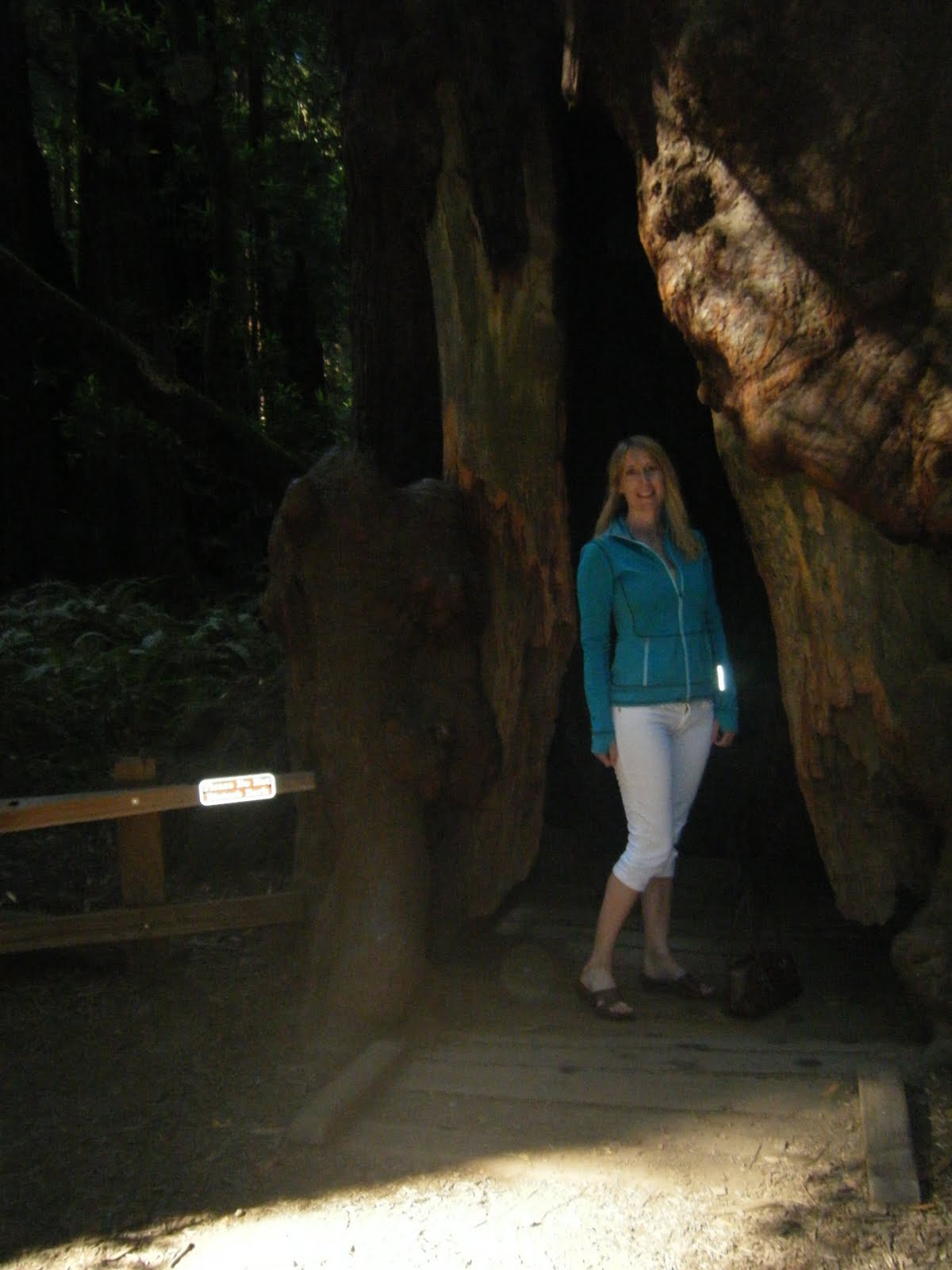
Michelle Ponto hanging out with the majestic trees
You can spend the whole day wandering around in this sanctuary as Muir Woods contains 6 miles of trails. There is a 1/2 hour loop, a 1 hour loop, and a 1 1/2 hour loop as well as longer hikes on trails that extend into surrounding parks. If you go, bring a jacket. The trees block out the sun making it chilly even on warm days.

Oh, and here’s another thing, don’t worry about the thousands of tourists visiting the woods every year. Even though both the regular and over flow parking lot were packed when I went, for some reason, the woods still seemed empty and there were many times on the trail where I was alone. It seems Mother Nature has room for all of us.

Monday, August 30, 2010

Bring your parents to work day

Sacramento Capitol Building. Arnold, where are you?
Believe it or not, my parents have not been to see me in five or six years. Don’t get me wrong. We’re a close family. It’s that usually I go home to see them and not the other way around.

But last week I got a call. They were on the road…and they would be here in about a week.

You know what that means. Yup, that’s right. It was time to do some serious cleaning that involved more than a quick vacuum and turning on the dishwasher. It was time to actually get out the duster and tidy up the closets.

Ironically, my cleaning frenzy was a waste as the whole time my parents were in Sacramento, we spent very little time at home. Instead, we spent most of it driving around. I took them to the Capitol building to see Arnold (but it was furlough Friday so no one was there), the rose garden, old Sacramento, around Midtown, and of course, Jamie’s. They had seen the “Diners and Dives” segment and it was the #1 thing to do on their list.

So what was #2 on their list? Come to the station and watch a newscast live.

Jamie's from Diners and Dives
It was then that it hit me that in all the years I’ve worked for TV, they have never been to any of the stations I have been at.

So I did what every news person does when their parents come to town: I gave them a tour of the station.

Then we plopped down on the sofa on the set and watched the News10 anchors Dale and Cristina get ready for the 5 p.m. show.

Within minutes, my parents realized the way they do the news is not like you see in TV movies. For one thing, there are no camera people or directors on the set. Instead, our News10 cameras are robotic and the director sits in another room (not behind a window, but down the hall) and talks to the anchors through their head sets.

My parents were also surprised at how quiet it was—but I guess it would be if there are only two people in the room.

Then during the break, I took them to the control room where they got to chance to watch the producer and director in action. I'm sure they thought this would be the boring part, but they were about to be enlightened because this is where the action is.

Just seeing these two people busy pushing buttons on the computer screen, as they gave the reporters, photographers in the field directions while cueing music, graphics and camera angles really opened my parents eyes to the fast pace of the industry.

Michelle and her dad doing the news at the anchor desk.
Of course, their tour of the station wasn’t done yet.

After the show, I brought them back into the studio to have a little fun with our Meteorologist Ken Barlow. It turns out my dad has a secret weatherman fantasy and couldn’t get enough of the green screen…or the anchor desk.

Needless to say, my little "bring your parents to work day" was a blast!

Monday, August 23, 2010

Surviving the Tour of Napa Valley Cycling Ride

Hundreds of cyclists spent Sunday pedaling in the 2010 Tour of Napa Valley Ride. I happened to be one of them and I must say it was a little more challenging than I thought it would be. Of course, being a little bit crazy when it comes to fitness and believing I am invincible doesn’t help.

If you love cycling and haven’t done the Tour of Napa Valley, you need to check it out. It’s gorgeous. You cycle through wine country along rural roads, along the shoulders of a couple highways and then through a few places that are off the beaten path. Because it’s a “ride” and not a race, you also don’t have to go fast as you won’t be timed and can leave anytime between 6 a.m. and 10 a.m. depending on how many miles you do.

They do have one rule though: You have to be done the ride by 4 p.m.

You also have the choice of three routes:

1) A 30 mile relatively flat course that winds along rural roads through the beautiful Napa Valley wine country

2) A 65 mile course that involves approximately 3,000 ft. of climbing (really it was 69 miles).

3) Or you can do the classic 100 mile route which has about 5,000 ft. of climbing

Being relatively new to cycling, I choose the 65 mile route because frankly I thought 30 miles wouldn’t be worth getting out of bed early and driving all the way to Napa. Don't ask me about my logic. In my mind it made sense at the time.

CYCLING FOREVER AND EVER

So off I went on my little 65 mile route, and at first it was all that I imagined it would be. The first 30 miles were relatively painless. We cycled past cute little vineyards, lots of grapes and horses relaxing in the sun. It was perfect.

But then the elevation started.

When they said 3,000 feet of climbing they weren’t joking. It was hard. Really hard. Especially as I have not invested in the special clip-in cycling shoes yet and only have the standard pedals.

Apparently, this is a big deal as everyone who passed me on the hills mentioned that the ride would be so much easier if I had the right shoes. Lesson learned. Shoes are now on the "to-buy" list.

Anyway, back to the race.

The 3,000 feet elevation basically takes place over two hills. I know this doesn’t sound bad, but it was.

I made it up the first hill okay – using the lowest gear on my bike. The hill was called the Ink Grade and consisted of 1,110 feet of climbing over 4.5 miles. My legs were a little shaky when I reached the top, but I did it. I was even happier when someone told me this was the steepest hill and the rest would be a breeze.

Ha! It turns out that person was dead wrong. The second hill was not easier. It was harder.

In fact, the hill was known as Howell Mountain, and is ranked as the fifth toughest hill to climb in Napa (The first hill was only ranked number 15). Howell Mountain is 2.2 miles of straight climbing…and my legs were killing me the whole way.

Already exhausted from the first hill, I couldn’t make it to the top without cheating. Yes, I admit it. I actually got off my bike and pushed in the really steep part, but at least I wasn’t the only one. Even the people who were still on their bikes weren’t going much faster than I was pushing. It was one of those misery loves company things...and believe me, we were all miserable even if we did smile encouragingly at each other.

WHAT GOES UP MUST COME DOWN

I did get on my bike again eventually and joined the slow pedallars as we crept up the hill. And as the road leveled off, it was all worth it.

Reaching the top of Howell Mountain never felt so good. It didn’t matter that I still had 25 more miles to go before the ride was done or that I still had a couple more short hills to climb. The hard part was over…and I made it.

Besides, once you’ve done all the climbing the real fun begins. You get to go down!!!

While my slowest speed going up the mountain was a pathetic 3.6 mph when pushing, going down my fastest speed was 46.2 mph. Yes, that’s right. It wasn’t a bird…or a plane…that streak was ME! Whoohoo!!

So will I do the 100 mile route next year? No way. However, I will definitely try the 65 mile route again…and next year I vow not to push my bike up the hill.

Monday, August 16, 2010

Romancing the souffle at The Firehouse Restaurant

While the cobblestone streets and boardwalk sidewalks in Old Sacramento are killer to walk on when wearing stilettos, it does have some good restaurants. So far I’ve been to Ten22 and some Italian-style restaurant by the water, but the one place I’ve been dying to try is the Firehouse.

I’ve heard from so many of my girlfriends about the wonderful food and how the place is one of the most romantic restaurants in the city. So naturally, I had to take myself there last Saturday night and I wasn’t disappointed.

First of all they have flights of wine. Now, I love wine, but because I’m a lightweight, I hate having to narrow down my choice to one glass. So when I see wine flights on the menu, I know I'm at restaurant that will soon become dear to my heart. If you don’t know what a wine flight is then you are in for a treat. It’s basically three glasses of three different wines—but instead of being big glasses, they are smaller pours. Basically you get to try three different wines for the price of one.

At the Firehouse, you could choose between three merlots, three pinot noirs, three chardonnays, etc. Because I knew I would be getting the duck (I love duck), I got the Cabernet flight. Yum.

I’m going to skip over my Shrimp bisque as it wasn’t out of this world and move right onto my main course –which was fabulous. The duck came with a dark cherry sauce and a Guinness forth. Whoever thought of adding Guinness to duck is brilliant and deserves to win a prize. The flavors are perfect together and I totally recommend it.

But I wasn't done yet.

After consuming my duck, I went onto dessert. Let me just say, the reason I only got the soup to start instead of something like their Dungeness crab cakes or the herb encrusted brie is because I cheated and took a peak at the dessert menu before I ordered. Yes, I am a girl and sometimes dessert comes first.

And here’s why. They have soufflé!!!

I have a thing for soufflé. Not only is it rare to find in restaurants, but it always comes with some sort of amazing sauce that you get to pour on like decadent syrup. So far my favorite one has been from Chez Phillip in the Peabody Hotel in Memphis where they had this chocolate orange soufflé with a rich anglaise sauce. So good.

At the Firehouse they serve a Grand Marnier soufflé. They bring it to your table hot out of the oven, then they open the top and pour raspberry coulis and a grand marnier/anglaise sauce into it. It takes 20 minutes for them to prepare, but it’s worth the wait…and every calorie.

As you can tell, I really enjoyed my night. I'm not sure if was all the romance in the air, but I definitely had a mini love affair with my food and savored every bite.

Follow Michelle Ponto on Facebook

Saturday, August 7, 2010

A taste of the French Riviera in…Malibu?

If you haven’t figured it out yet, I love the ocean. So while in California, I’ve been checking out the coast in different areas – starting in the north and slowly working my way down to the southern beaches where you can actually wear a bikini and not a fleece-lined jacket like you do in San Francisco.

I swear I get fooled every time. I mean, who would have thought you could be sweating buckets at 104 degrees in Sacramento and then drive 90 minutes to the coast to discover it is only 70 degrees there? It’s completely deceiving -- not to mention freezing!

Anyway, this time I wanted to go to “real” beach so I headed to Malibu.

I had never been to Malibu, but I have always wanted to go. Not just because it’s the supposedly where the mega-rich Los Angeles people live, but because of that sitcom “Two and a Half Men” and of course, the Malibu Barbie commercials from the 80s. Yeah…not exactly the best reasons to go, but whatever, I was going.

The drive to Malibu from Sacramento isn’t that bad. It takes about 5 and a half hours, but it goes by quickly. But that could just be me as I have no problem driving the 9 hours to Vegas from here. I’m sure there are some of you who are thinking that’s a little too long to drive just to check out where Charlie and Barbie live.

LUNCH ANYONE?

So was the beach worth it? Not really. It was nice and much warmer than Half Moon Bay and San Francisco, but it’s not like the beaches in Clearwater or Hawaii. The sand wasn’t as soft and you had to kick the seaweed away to make room for your towel. Still, the waves were nice to watch and you could wear shorts without shivering.

While the beach was just okay, what was worth the trip was the lunch.

If you’ve been to any beach then you know what kind of food you can usually find in the nearby places. It’s usually burgers, deep fried fish sandwiches, maybe some cheesy tropical hut place that serves breaded shrimp, beer and watered down margueritas.

Now, don’t get me wrong. I don’t have a problem with those places and have eaten at them a number of times. There were even a few by the beach in Malibu where I was.

But…when given a choice between a deep fried fish sandwich and a cute little French Bistro, you know which one I’m going to choose. Yup…that’s right. The one that has clean restrooms.

MEET DANIEL FORGE OF BEAU RIVAGE RESTAURANT


You’ll find Beau Rivage off the Pacific Coast Highway and it’s totally unexpected – or at least I didn’t expect it.

You’re walking, feeling hungry, passing the fried joints, when suddenly you see it.  The European style building surrounded by flowers.

Just one look at the little bistro tables and real linen table cloths and I knew this place would have a 4-star wine list.  Suddenly the sand in my flip flops and in my hair didn't matter anymore and neither did my wet shorts.  I was going to eat...and I was going to eat well.

Eating at Beau Rivage is like eating in Provence. The food is fresh and enhanced with fresh herbs and olives. This is because the owners are the real deal. 

Owner Daniel Forge is from France and owned a hotel in Nice with his brother before moving to California 25 years ago and opening the restaurant.  His wife Luciana is from Italy and was a professional opera singer from Rome. And there is no mistaking that they know food and have brought back some of the good stuff from the Riviera.

There is also a Sunday brunch where they have a classical guitarist, but because I was having lunch at 3 p.m. I didn't get to see that.

Still, my late lunch was incredible.  Even though I was not dressed for eating in a fancy restaurant and had absolutely no make up on (I did just come off the beach), Daniel was a gracious host and treated me like I was a millionaire. 

He recommended a pan-seared sea bass with a light sauce -- which was incredible.  It melted in my mouth and was the perfect way to end my Malibu beach trip.

Sadly, I didn't get any wine as I still had a 5 hour drive ahead of me. But next time, I'm going here first and will just watch the waves from their big bay windows.

Follow Michelle Ponto on Facebook

Monday, August 2, 2010

The cutest little wedding in the heart of wine country

Sometimes the best events are those where you don’t know anyone at all – at least that was the case this weekend when I attended a wedding in the heart of wine country.

As the emergency back-up date for my friend, I got the chance to attend Gloria and Jack’s wedding. Did I know Gloria or Jack? Well, no…but after spending an evening with 40 of their closest friends I now feel like I do.

I swear everything about this wedding was cute. Really cute.

It started with the location. It was held in a farmer’s market in Occidental, CA. So now I know what you are thinking because I was thinking the same. A farmer’s market for a wedding? How’s that going to work?

Believe me, it worked. The ceremony really was in the middle of the farmer’s market. Their wedding helpers (the guests that had arrived early) transformed a parking lot/alleyway into this romantic spot filled with checkered table cloths, wild flowers and food.

“We had our first vacation together in Occidental and we loved the farmer’s market,” said Gloria. “We decided the perfect place for our wedding would be in a place where we had great memories.”

If you haven’t been to Occidental, let me fill in. This place is darling. It’s about 2 hours from Sacramento (on a day when there is no traffic, but it's much longer in reality as there is ALWAYS traffic) and located in Sonoma County on the Bohemian Highway which is rated as one of the most scenic highways in North America. I’m not just saying that because it’s curvy and is lined with vineyards, trees and little town. There are sites on Google that agree with me.

“The coastline is also nice,” said Jack. “You just turn at the corner and drive about 10 minutes to the water.”

I never got around to doing that as the fog rolls in around 9 p.m. and while those winding roads are fun to drive during the day, they are a little scary to drive at night. I don’t know about you, but fog, winding roads and darkness always bring back memories of “American Werewolf in London.” I’m sure at any moment some giant black wolf is going to leap onto my car, smash through my windshield and rip out my neck - which would totally not be a good thing.

So while I’ll be saving the beach trip for another weekend when the sun is out, the wedding was worth the 2-hour trip. Not only was it cute, but the food was to die for. This did not come as a surprise to any of the guests, but little did I know I know Gloria was an award winning cook and is known for her food.

So what did they have? Well, keeping in with the whole farmer’s market theme they started off with fresh loaves of mushroom bread at the table. This bread was so fresh, it was still warm when we broke it open – and remember, we were in the middle of a parking lot. There were no microwaves to warm it up No, this bread was fresh from an Occidental bakery - and again, just like the farmer's market, the bread had meaning for the couple.

"Jack loves this bread. When he says he's craving some fresh bread, I know he's not talking about going to the bakery down the street in San Francisco. He's talking about this bread," said Gloria.

Next on the menu was this Spanish cheese with quince jelly. It sounds so simple, but that was the beauty of it. Again, it was fabulous and I had to hold back from totally pigging out on it, because a) that’s a little rude and b) because there was more food to come and I needed to save some space in my tummy.

Then came the shrimp and garlic. A little messy to eat, but by now we were all family and what’s a little shrimp juice among friends?

After the shrimp, it was time for the good stuff. The stuff I had been watching simmer since I arrive. The stuff that was making my mouth water just from the smell.

The stuff known as paella.

I’m just going to say, this was the best paella I had ever had. They had a seafood and chicken one for people like me and then a chicken and sausage one for the meat eaters. My friend tried both versions.

“We loved the paella from the farmer’s market, so we had to share it with everyone,” said Gloria.

I'm glad they did. I may have to make a trip up there just to get some more.
 
So now that I told you about the food, let me tell you about the ceremony, which was just as amazing.

Gloria and Jack wrote everything themselves -- from the readings to the vows. They told the group how they met, how they made each other feel when they were together and their hopes and dreams for the future. Gloria even told everyone that Jack was the most amazing kisser --which I must say is a good trait in the man you will be kissing for the rest of your life.

Needless to say, there were many tears shed and the cloth handkerchiefs they handed out came in handy.

I may not have known Gloria and Jack when I drove into Occidental, but I'm now proud to be one of their friends.

To the newlyweds...wishing you all the happiness in the world - today and for always!

Follow Michelle Ponto on Facebook