Wednesday, December 31, 2014

Haiti Day 4: Sweating it out on New Year's Eve


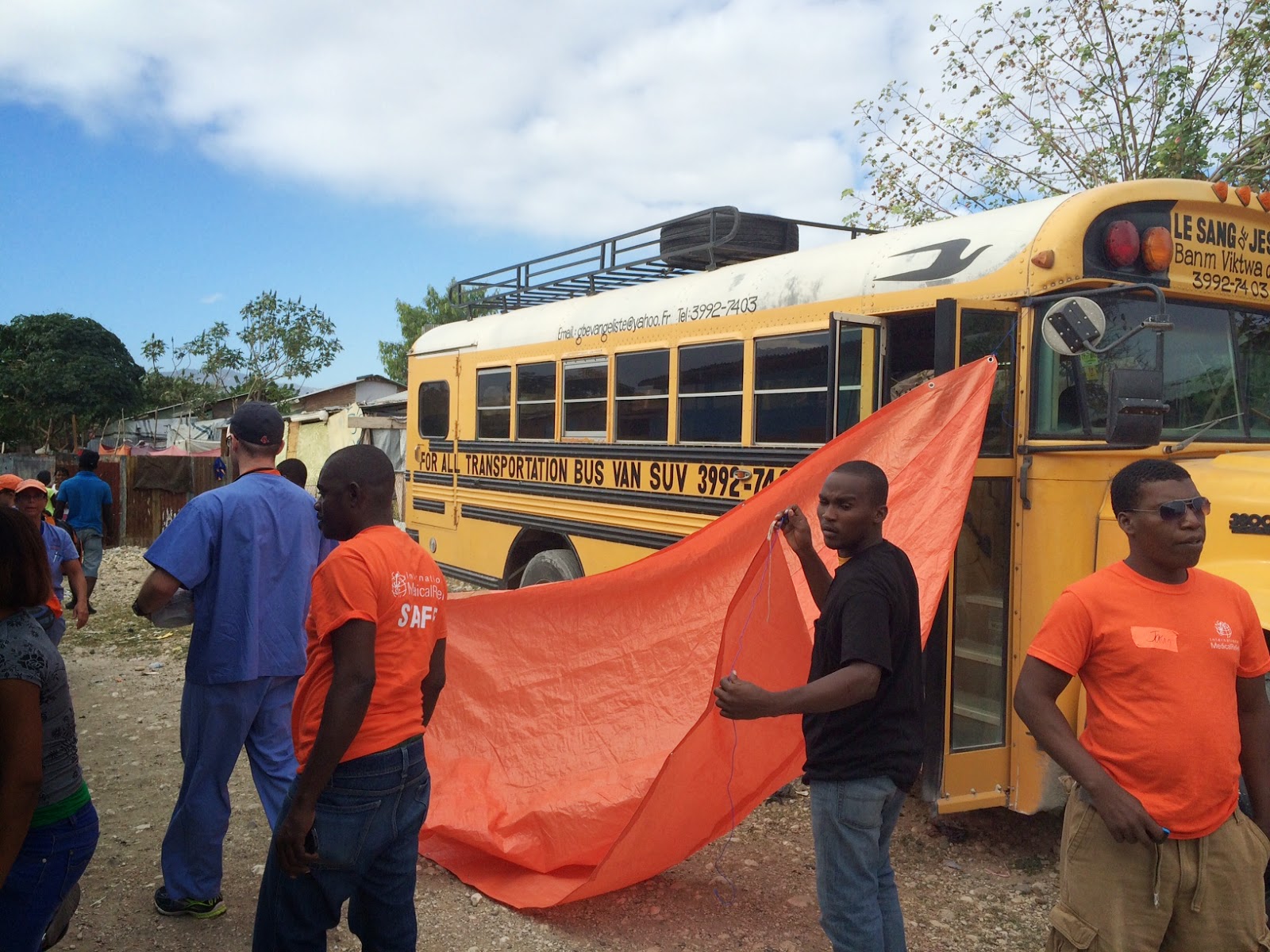
It's Day 4 of the Haiti Medical Mission Trip with International Medical Relief and today we were at a community that looked a bit like an enclosed compound. We drove through a high gate and into a walled in area where about a dozen structures were set up. Some of them were metal silos with a bunch of bunk beds inside and others were made out of concrete cinder blocks with crushed stones for a floor and nothing else inside.

We set up the pharmacy in one of the metal silos, while triage and community education shared one of the cinder block homes. Well- and sick-care were set up under a tarp outside. At 7:30 in the morning it was already hot, so we needed the shade we could get. 


Many of our patients came in with the same symptoms we had seen at the other locations: UTIs, STDs, dehydration and worms. But there were some interesting cases. We saw a woman who had cataracts in both eyes and was so anemic her teeth were bleeding. She looked like she was an older woman (like in her 60s) so we were surprised to learn she was only 40. Unlike in the U.S., getting surgery to remove it from a person’s eyes is rare in Haiti. 

“It’s sad. She’s so young and already the cataracts has made her nearly blind,” said med student Caitlin.


We are always learning something new on this trip -- even those who have been in the medical field for a while. Nurse Patti took the lead on what we called our mini clinic. Our location was by an orphanage. We had 56 children and adults come over that needed treatment. She sat them all down in a room and with the help of two other mission volunteers, they treated them all and made sure they all got worm pills.


But with the good times, there are always those moments that bring us back to reality and the importance being there. Nurse Amy had a infant who came in with its aunt. The poor baby was so dehydrated, the soft spot around its head was sunken in. 

“It was crying and was so hungry, yet there were no tears,” said Amy. “We started giving it some water and now it has tears. Its also so much more happy and content.”


Another first was this six-year-old girl who came in complaining about ear pain. We took a look inside her ear and saw she had a fly in there. Judging by the amount of wax that had built up around it, the fly had been in there for a while. 

“At first we tried to get it out with a tool, but it was too deep. We had to use a syringe,” said nursing student Mackie. “The girl was so scared. She was flailing and trying to get away from us, but eventually we were able to calm her AND get the fly out.”


We set a new record that day by seeing 329 patients plus the 56 from the orphanage. Already, we are beginning to run out of medications to treat many of the fungal infections and other common issues the people had. We also ran out of Tums. We can’t believe how many we have given out, so if you ever come to Haiti on a mission, bring Tums. Lots and lots of Tums.

Related posts:
Haiti Day 1: Start of Medical Mission Trip
Haiti Day 2: Transforming a school to a medical clinic
Haiti Day 3: Venturing out to help in rural areas
Haiti Day 4: Sweating it out on New Year's Eve on a Mission Trip
Haiti Day 5: Final day of the International Medical Relief mission
Haiti: The boy with the foot

Tuesday, December 30, 2014

Haiti Day 3: Venturing to the rural areas


Getting on the bus this morning was the beginning of a new adventure. We had to get up an hour earlier, but it was worth it to help the people living in the rural areas of Haiti.

Outside the city, the walls are gone and the mountains takeover the horizon. There’s green grass, little farm crops, palm trees and tiny villages. We also saw goats (and the cutest baby goats EVER), sheep, cows and donkeys in the fields. There aren’t herds of cows like you would see in the U.S.; they only have enough animals for the family to live on. There weren’t any stores or shops by the little village we visited, so basically the family needs to grow or raise their own food to survive.


Our set up today was in a church, which meant we could use the benches for patient/provider seating and creating natural barriers for each station. Just like on the other days, as soon as we rolled in, people started to line up outside the door. One of our first patients was an farmer who came in with one shoe and resting his weight on a stick. His other foot was shoeless because it had a nasty burn on the top and infection was starting to set in.


He told us it happened eight days ago. He was making peanut butter, and when he was heating the oil to mix into the peanuts, it fell off the stove and spilled on his foot. He’s been in a lot of pain since and hadn’t been able to sleep. We cleaned the burn to reduce the infection and then showed him what he would need to do to keep it clean and help it heal.

There were a couple cases of TB again today. While that’s no longer new to us, what was new was that the people knew they had TB but were not able to afford treatment so were living with it. But it was the kids that stole our hearts again at this location.


Unlike the patients from the camps, these patients came dressed in their best clothes. The little girls were in dresses, and we could tell the parents took special care in getting ready and making sure everyone was clean to see the doctor. Malnourishment was a common issue, and many of the people and babies hadn’t eaten for a day or even two days.


“You can tell they haven’t eaten because when I listen to their intestines, they sound hollow,” said Dr. Amanda. “Normally, you would hear sounds in there because of the food.”

But what made the situation more desperate was when a family came in with a young girl who had a tummy ache. It turns out the girl was so hungry she had been eating dirt. They try to mix it with water and make a soup out of it. Some of families are able to grow some food but they often end up selling it as that’s their only means of income.


To help them, our team handed out supplements and tried to educate them on nutrition. We also educated them on worms – and how to reduce their chances of getting them. Worms are so common in the locations where we are conducting our missions, that nearly every patient is prescribed pills to get rid of them. We even had a 3-month-old baby who we suspected had worms. Every time we touched it’s little tummy, you could tell from the kicking feet that it hurt.


Alex, our 15-year-old super volunteer, had her best day so far. Alex has been assisting our fearless leader Linnea on the mission and has been going non-stop. Today she got the chance to work in the community education station. “I want to work in the medical field more than ever now,” she said. “Today I got to interact with the patients more by teaching them about personal hygiene and it was so fun.”


In total, we saw 331 patients, the most we have seen in a day so far. Again there were numerous STDs and patients with low iron, but we also had some critical patients, including a 19-year-old girl we had to transport to the hospital.


“She had malaria before and was treated for it. But now all her symptoms are back. She’s got a fever at night, she’s vomiting after eating, she’s lost weight, etc. So she’s worried she has it again,” said Dr. Amanda.

 Listening to her lungs wheeze and watching her gasp for breath, helped us make the decision to send her to the hospital, but because the village was located in the middle of nowhere and she was unable to get there herself, IMR took care of the transportation costs for her.  It's a small thing, but it just may have saved her life.

Related posts:
Haiti Day 1: Start of Medical Mission Trip
Haiti Day 2: Transforming a school to a medical clinic
Haiti Day 3: Venturing out to help in rural areas
Haiti Day 4: Sweating it out on New Year's Eve on a Mission Trip
Haiti Day 5: Final day of the International Medical Relief mission
Haiti: The boy with the foot

Haiti Mission: The Boy with the Foot

I'm learning that with every mission trip, there are a few patients who we will never forget.  So far on this trip, it was the one we call "the boy with the foot."

He came in towards the end of our first day.  He was 15 years old and was limping. When he took off his shoe we saw why. His foot was deformed.


He told us that he had been in fire when he was a year old.  His foot had burned so much that the tendons were destroyed. Then because the tendons were gone, when the burn healed and the skin grew back, the toes ended up healing on top of his foot as there was nothing to hold them in place.  In other words, they were curled up over his foot.


“What was so amazing was that his chief complaint was his foot was itchy. He didn’t complain about his foot being deformed and he has been living with it for 15 years. That wouldn’t happen in the U.S.,”  said the med student watching Dr. Amanda treat the teen.

The boy had come in with a severe case of athlete's foot.  Because of the way the toes were, it was easy for fungus to grow.


"In the U.S. we would have removed the foot and fitted him with a prosthetic years ago.  But here that won't be possible. Instead, I'll show him how to clean out the fungus and how to keep the area clean so it doesn't get itchy again," Dr. Amanda said.

What amazed all of us was how accepting the boy was to his condition.  He didn't expect miracles or complain about the way the foot looked. He just wanted it to stop being itchy.

Related posts:
Haiti Day 1: Start of Medical Mission Trip
Haiti Day 2: Transforming a school to a medical clinic
Haiti Day 3: Venturing out to help in rural areas
Haiti Day 4: Sweating it out on New Year's Eve on a Mission Trip
Haiti Day 5: Final day of the International Medical Relief mission
Haiti: The boy with the foot

Monday, December 29, 2014

Haiti Day 2: Transforming a school to a clinic


What’s always amazing is how IMR is able to transform any space into a clinic. Today it was a school, but it didn’t look like any school we had in the U.S. This one was a long narrow structure made out of plywood. The floor was dirt and the partitions between the rooms were chalkboards.

When we got off the bus and saw the location, you could tell we were thinking, “Okay, now what?”. But within minutes Dr. Amanda and our team leader Linnea had a plan for the flow of patients and it was time to scramble to find benches, tables and chairs to make it work.


Our little team dramatically improved upon the day before and had already figured out improved ways to do things. We understood the routine, the amount of patients we would be seeing and the space needed to be efficient and provide quality care at the same time. Cases like possible TB and malaria were also no longer a novelty. We also had the mask situation under control – and each section was warned to “mask up” when a possible case was entering their station. 


When we arrived we were told Chikungunya was going to be one of the most common cases that we would be seeing. It’s something passed on from mosquito bites and has infected 250,000 people in the last seven months in the area. We had seen multiple cases on day 1 and the same on day 2, many of the people suffering from the pain in the joints that lasts after the disease has been treated. 

“We can give them something for the pain in their joints but that’s about all we can do. The body will eventually heal itself,” said nurse Amy.


Severe dermatitis was also something we were seeing. Today a young woman came in with her legs covered in dark bumps. While they looked bad, they were curable just with better hygiene. “If they don’t exfoliate enough, the dirt can build up and cause the problem,” said Dr. Amanda, while testing the bumps by scraping off a bit of one to make sure it was only dirt/skin. 

She said you see this in the U.S. on people who can’t bend over and scrub their legs. After exfoliating her legs and showing the girl how to do it herself, she was on her way.


Young mothers and young babies seem to dominate our clinic, and nurse Amy’s most memorable patient of the day was one of them. A tiny newborn was brought in dressed in 6 layers of clothes. The poor thing was wheezing. After undressing the little girl and letting her cool off a bit, she started looking a little better and we could finally examine her to see if the wheezing was heat related or something else.


There are times during the day when you are seeing patient after patient that you wonder if what you are doing is helpful.  But then you get a case where you know you may have just saved a life.  This is what happened when a 10-year-old boy came in with malaria. His mother had no idea what was wrong with him. She said he slept all day and was tired all the time. 

“You knew something was wrong with him by looking at him. He looked sick,” said nurse Jodie. “We tested for malaria and it came back positive.”

We let the mother know and referred her to the hospital. “I hate that we don’t have medicine to treat it here, but at least we could diagnose it and let her know so she could get help,” Jodie said. “It’s times like this when you know what you are doing is worthwhile.”

Related posts:
Haiti Day 1: Start of Medical Mission Trip
Haiti Day 2: Transforming a school to a medical clinic
Haiti Day 3: Venturing out to help in rural areas
Haiti Day 4: Sweating it out on New Year's Eve on a Mission Trip
Haiti Day 5: Final day of the International Medical Relief mission
Haiti: The boy with the foot

Sunday, December 28, 2014

Day 1: Haiti Mission Trip

A street in one of the villages in Haiti
It's been two years since my last medical mission and I've been wanting to do another one since then.

The first one I did was in Guatemala in 2013 and that one was fantastic (read blog here).  This time I picked a mission through International Medical Relief (IMR) - http://www.internationalmedicalrelief.org and it took place in Haiti just after Christmas.

Sleeping in our bug tents as the area was at risk for malaria
When our team of nearly 40 volunteers arrived, it was clear Haiti was still struggling after the earthquake that happened in 2010.  Our first day at clinic was in a camp that was set up after the earthquake as temporary housing.  But these weren't houses like we have in the US.  They were temporary tents and makeshift structures constructed out of plywood and tin that were still being used as homes for families.

Many of us hadn’t seen poverty like this before, but there wasn’t time to let the reality of the people’s life soak in as we had so many things to do.

As soon as we set up triage and the community training stations, patients started arriving by the dozens. 


Our very first patient was an elderly woman who was literally carried in by her son (or it may have been her grandson -- she was 68). She told us that about a year ago her limbs started feeling numb and she could no longer walk. She also said she was also diagnosed with pneumonia in November and hadn’t had her prescription filled yet, most likely because she couldn't afford it.

Because we were just a day clinic, there was only so much we could do for the people there.  We couldn't perform any surgeries and we couldn't do anything that would require follow up care with a doctor as we would only be there for a short time.

As a result, there was nothing we do for her numbness or to help her walk, but we could fill the prescription for pneumonia.

It was a sad way to start the day as the family had waited so long for us to arrive and were so hopeful that we could help the old woman walk again.  It was devastating to watch her family carry her out at the end, but there was only so much we could do with the tools we had.


One thing that surprised us was how many young children and babies came in with their parents or grandparents. 

One of these little guys was an 11-month-old baby with a fever of 103.2 and a bit of pneumonia. With his temperature so high, we needed to treat him while still in the clinic. Without immediate treatment and reducing his fever,  the doctors were worried he would seizure. 


Another sad case was this dad who came in with his three kids asking if he could have blood for his wife. All of the kids were dressed as if they had come to the clinic straight from church. They all sat quietly in a row, waiting their turn.

He told us that his wife had given birth to another baby a few weeks ago, but the baby had died. She really needed blood but they couldn't afford to go to a hospital. It was so sad to hear his desperation.

But we weren't a hospital; only a portable clinic.  We had medication, but blood or even medication that required refrigeration were not items we could carry.


Natalie, one of our nurses said one of the patients that touched her on this first day was this tiny baby who came in with a skin infection. The babies body looked like it was cover is red blisters and in some areas, it was so bad the skin was scaling off.

“With her skin like this, she’s at risk of infection…if there isn’t one in there already,” she said.

In this situation, IMR transported the baby, grandmother and mother to a nearby hospital to get medical attention there.


While we were able to help this family, there were some serious problems in the community we couldn’t treat.

“What’s been disturbing this time around is the number of sexual abuse cases we’ve seen in young girls,” said Dr. Amannda, who was on her third Haiti trip.

We saw so many patients with STDs. It was surprising.

“It’s because of the lack of knowledge. They don’t know the risks….and then you have the lack of hygiene,” she said. "They don’t know how to clean. There is dust and dirt everywhere, and then there is the garbage. It’s simply thrown at the side of the streets and because of the heat, it often self combusts. Kids, many of which don’t own shoes, fall or step on the burning pieces and end up with burns or lacerations."


She says many people working in missions wonder if they are helping in vain. “But if only one person listens, they may tell their sister or their cousin and you never know how far the knowledge will go,” she said. “You help because it’s the right thing to do. You help even if it only helps one person that day.”

Tomorrow we’ll be at a different camp…but after day 1, we’re now prepared for what we’ll be doing.

Related posts:
Haiti Day 1: Start of Medical Mission Trip
Haiti Day 2: Transforming a school to a medical clinic
Haiti Day 3: Venturing out to help in rural areas
Haiti Day 4: Sweating it out on New Year's Eve on a Mission Trip
Haiti Day 5: Final day of the International Medical Relief mission
Haiti: The boy with the foot

Sunday, November 30, 2014

Inspired by a great mind who studies brain energy

Tea, stuffed toy mice and stimulating conversation around the desk of Prof. Pierre Magistretti

When I was six years old, someone told me that we only use 10 percent of our brains.  After that I was determined to use 15 percent of mine just to beat that statistic.  Whether I've actually achieved that or not is up for debate as my early endeavors to bend objects with my mind were not successful.

But I'm not the only who thought the "10 percent" notion needed to be debunked. Dr. Richard Cytownic (http://cytowic.net) has argued that brain regions once believed to be silent are actually humming with activity.

As you can tell, this whole brain energy concept and how neurons work is fascinating to me, which is why when I got the chance to talk to KAUST's Dean Pierre Magistretti, I was thrilled.

Magistretti's field of research is brain energy metabolism and looking at the mechanisms that regulate the delivery of energy to active neurons. He's been working with the university's Viz Lab to actually show visually how this works.

Magistretti was recently honored for his work with glia cells. "Everyone knows neurons, but there is another population – the other half of the brain – which is glia cells. We showed that a type of these glia cells, known as astrocytes, can detect when neurons are active and import energy in the form of glucose, oxygen as well as increase blood flow in the activated area," Magistretti told me during the interview.  

He was recently honored for his work with glia cells.  And talking to him about how he got into this work years ago and where it sees his research going in the future was inspiring.

Read more about my conversation with him at: http://www.kaust.edu.sa/latest-stories/dean-magistretti-awarded-honorary-caps-membership.html


Thursday, November 13, 2014

The Best Oyster sandwich in New Orleans


New Orleans is one those places where you can always find good food and good music.  On my last visit, I stayed in the Warehouse District and it's my new favorite part of New Orleans. So many great restaurants and some cool art galleries.

This delicious delight was from Cochon Restaurant. I ordered an Oyster Sandwich (without the bacon)- because I like oysters and somehow I thought it would be low fat.

Ha!!! I never thought it would be fried oysters -- then I remembered I'm in the South. It's all fried. It was about a billion calories but soooooo good.  I was tempted to go back a second time and get it again.

If you have a visit coming up at Cochon, it's located at 920 Tchoupitoulas Street and is worth dropping in for lunch -- although if you can, make a reservation as there's usually a long wait.  The executive chef is Donald Link who earned a James Beard award for Best Chef South.


Monday, November 10, 2014

3 Things You Need to Know About Maldives


Maldives is located in the Indian Ocian- Arabian Sea area and is located about 750 kilometers south-west of Sri Lanka, making it a short 90 minute flight and the reason I decided to go after visiting Sri Lanka.

Maldives is made up of 1,192 coral islands grouped in a double chain of 26 atolls that are composed of sand bars and coral reefs. It's spread out over 90,000 square kilometers. So what does this mean to you? It means that Maldives is basically a bunch of islands and if you like snorkeling and diving, you will love it.


Before you pack up your bags and book a ticket, here are 3 things you need to know:

1) It’s an island paradise, but it’s far: Here’s the thing. Maldives is beautiful. There are huts on the beach and those cool huts that have the glass water bottoms. There are gorgeous beaches and there are water things to do, but frankly, it was very similar to what you can get in Belize and some Caribbean resorts.

So if you live in the west (like Canada and the US) and all you want is one of those huts and do some snorkeling on your honeymoon, then it might be better to splurge on a resort on that side of the world. The flight from the US is over 24 hours and Maldives is expensive. But if it’s on your bucket list, do it. You won’t be satisfied with any other place so you might as well experience it as long as you know the pros and cons.

If you live in Europe or the Middle East, then come on over the Maldives. For you it’s close and would be worth it for a tropical getaway. From my research, it is cheaper than Seychelles, but more expansive than Bali and Phuket. There are beaches in Sri Lanka, but they aren’t as developed as the Maldives resorts which really cater to expats and westerners.


2) Each resort has its own island: This is cool and not cool. It’s cool, because you are staying on an island that only caters to your resort. It’s romantic and isolated.

But just like the crew of Gilligan’s Island could not leave, you won’t be able to leave your island. So make sure you research everything. All your meals, activities and everything else will be limited to one place. And every island has its own “tourism” hook depending on what’s around their reefs. Some have turtles, some have surfing, some can only offer generic snorkeling, some have night clubs, some are for families, some are mostly for couples – so make sure you book one that has the stuff you want to do. There are 106 resort islands to choose from and they range from affordable to luxury – so you should be able to find one that works for you.

Also note that because you are trapped on an island, things are expensive. You have no other options so they can over charge you – and because it’s an island where everything has to be shipped in, things are also expensive because of that.

Plus, you will have to pay for transport to and from the island. Generally, you will fly into Male. From there, the resort you choose will either get you there by sea plane or by boat. Seaplane is about $400 per person for the return trip. The boat option is cheaper, but you still need to factor that in. The seaplane also has a luggage weight restriction and only flies during the day – which means that if you land late at night in Male, you will need to get a hotel for a night before you get to fly to your resort.

The bonus of this is that is super cool to take a seaplane to your island vacation. I mean, really super cool! Plus, the aerial view makes for amazing photos.


3) Limited culture: Unless you are staying in a guesthouse in one of the 5 islands that are actually inhabited by local Maldivians, you won’t experience the “real” Maldives.  Maldives is a Muslim country so alcohol is not allowed except in resorts and the religious laws need to be respected if not on a resort island.

If you stay at one of the 106 resort islands you won't have to worry about that.  Alcohol will be available, English will be spoken and you can sun bathe freely at the beach.  The menus will also cater to what westerners like and at the resort I stayed at, even the prices were in US dollars and not in Maldivian currency.  It will feel very comfortable to people looking for a traditional island experience with a Western feel.

But if you were hoping to eat real Maldivian foods, shop with the locals and see how they live, that won't happen on the resort islands.  For some people, that won't matter as they came for the pampering and relaxation in a tropical setting.  But if you are the type who likes to really get to know a country's nuances, the island resorts might be disappointing. They are beautiful. Don't get me wrong. They are just designed for western comfort.

We went after spending two weeks in Thailand and Sri Lanka where it was culture overload (in a good way), so a little "normalness" in a relaxing environment was a great way to end an action packed vacation.

So that's my honest opinion about Maldives.  If you are looking for a tropical experience, are prepared for a long plane ride (if you live in Canada or the US), and want pampering over culture, you will love it -- especially if it's on your bucket list.

It's a great place to unwind and feel like you are away from the problems of the real world.    

Saturday, November 1, 2014

Eco-Friendly Luxury in Sri Lanka

View of Kandy in Sri Lanka

When traveling to new places, it’s always a bit of a gamble to find accommodations that are amazing, yet reasonably priced – unless you are planning to stay in a chain hotel. I’m a bit of an adventurer, but I admit there are a couple of chain resorts that I love including the Four Seasons, The W Hotel, Anantara and a few other luxury lines. And while, I love these resorts, in truth I can’t always afford them (actually I rarely can afford them and can only justify staying if I can find a deal).

Then there are times when a boutique hotel is too tempting to resist, none of my standby places are located in the area I wanted to stay, or in the case of Sri Lanka, the country is just too interesting to risk being watered-down by a chain hotel. You want to stay in a place that is owned by someone who lives there.

So then the research begins. For me, it starts with Expedia just to get an idea on prices in the area and from there the search extends to AirBnB.com, Dwellable.com and homeaway.com. I then do extensive google searches to see what other bloggers recommend and what articles have been written about the area.

View of the grounds at the Bougainvillea - best eco-friendly resort in Sri Lanka (in my opinion)

I also have a folder on my computer full of links to cool places and bucket list ideas. It was in this folder that I had saved the information on the BV-retreat.com, aka Bougainvillea Retreat. (url http://www.bv-retreat.com)

The infinity pool at the Bougainvillea Retreat in Sri Lanka

This little gem of a place was written up in the CNN travel section on the best eco-friendly resorts in Sri Lanka. It’s located 30 minutes out of Kandy and is the last villa on one of the roads leading outside the city. It’s tranquil, gorgeous and exceeded all my expectations.

Relaxing poolside sofas at the resort.

Pi, the woman running the boutique resort is doing it on behalf of a friend and was so helpful. The only thing I knew about Sri Lanka when I booked the trip was Adam’s Peak was something I wanted to do and I knew from the blog posts I had read, that it was located somewhere around Kandy. What I didn’t know was that the airport is not located by Kandy. The airport is in Colombo and because the roads are so winding and busy, it’s a 3 to 4-hour drive from Colombo to Kandy. 

At first I thought, no problem, I’ll just rent a car, but Pi warned me that the roads aren’t really well marked, signage is an issue and people drive like crazy around the tight curves. Instead she offered the BV-Retreat’s driver for $70 a day. He would even meet us at the airport and drive us to the hotel so we wouldn’t have to worry about being stranded in a new country.

This turned out to be the best deal ever as the roads are a little crazy there.  I doubt I would have ever found the hotel from the airport. Plus, the driver took us to places we didn't know existed like the elephant orphanage, an herb farm and little temples in villages, etc.  He also did the talking for us as not everyone spoke English.

The living room with the view of the pool at the resort

The Bougainvillea has only 8 rooms and when my girlfriend and I arrived, we were the only people there – and had the house to ourselves. I also got it on a “stay two nights get the third night free” deal and this included a custom made gourmet breakfast. Not bad for $150 a night!

Our little table that they set for us each day.


Each day they would set up our little table for two. They only made enough food for the guests (us) and it wasn't like a restaurant where you could order. They gave a couple of choices in the morning and then would have it ready for us in time for dinner.  They always had a western and Sri Lankan option. I highly recommend trying the Sri Lankan option. Their food was so incredible and you won't find anything like it back home.

Another view of the pool


Also, you have to try their tea.  Sri Lanka is famous for their tea.  You'll see the fields all over the mountains. They brew it with real leaves (not bags) and they like it strong with milk.  I just like it strong so for me it was perfect. 

By the way, if you are thinking of retiring someplace, the owner told me this house with its infinity pool and amazing view was only $40,000. My only regret was not having more time just to sit and do nothing.  This place was so wonderful, you didn't want to leave.

Monday, October 13, 2014

Hiking Adam’s Peak in Sri Lanka

Adam's Peak on a clear day -- not the day we went (Photo from Wiki)

My main reason for coming to Sri Lanka had nothing to do with elephants (they were an unexpected perk). My main reason was Adam’s Peak.


Me at the start of the 5,200 stairs wearing my $4 rain jacket (bonus!)
What? You’ve never heard of it? Well, me neither…until I did a Google search on “what to do in Sri Lanka.” And there is was. Adam’s Peak. This majestic mountain is full of history and was there waiting for me to climb.

 I mentioned it to my friend Christine in Houston and she was instantly up for the challenge. What’s amazing about Christine is that even though she nearly died from exhaustion on the crazy Grand Canyon hike I took her on, but she was totally into pushing her body to the limits again.

Usually these stairs would be packed with pilgrims - but not during rainy season.
But this time her sore muscles would be for a good cause. It would be for the myth…or myths that go along with the mountain.

Reclining Buddha -- what we wanted to do after climbing to the peak.
You see, Adam’s Peak has all these stories attached to it. The Buddhists believe the rock formation near the top of the mountain is the footprint of Buddha, in Hindu tradition it’s the footprint of Shiva and in Islamic and Christian tradition, it’s Adam’s footprint that’s way up there.

Well, we were going to leave our footprints up there too and do the pilgrimage to the top.

Entrance to Adam's Peak
The pilgrimage season is December until May with an average of 20,000 people climbing the 5,200 steps to the top each weekend. They usually start their climb at 2:30 am and end at the top just as the sun is rising at 6:30 am. The view is supposedly spectacular.

Only during the rainy season will you see these waterfalls. 
We were going in October, which is not pilgrimage season. The reason there are no pilgrims is that October is in the rainy season. In fact, we almost didn’t get to climb it as the rain had caused a landslide a few days earlier and part of the trail was closed.

 Thankfully, they were able to clear the area and reopen the trail the day of our planned hike.


Getting closer.

Climbing Adam’s Peak during the rainy season is interesting. First of all, it’s rainy (duh) – which also means it’s misty and cold. The stairs are also a little slippery.

Secondly, you will be the only crazy people hiking it in the rain. Instead of the thousands of pilgrims that hike it in the dry season, we saw maybe six other people in the four hours it took us to get to the top. Yes, that's right. We had the mountain to ourselves!

The only vendor that was open. 
One other thing you won’t find is vendors. Normally, there are little shopkeepers selling lights, food and beverages to keep you going along the way. There was only one open when we went – and we were so happy to see him. Really, really happy!

The Buddha near the top of the mountain

Finally, you may not see anything when you get to the top. Rain means clouds – and when you climb over 5000 steps up a mountain, you are pretty much in the clouds.

The temple at the top. As you can tell, I was way up in the clouds and could see nothing.
But it’s totally worth it. The scenery is beautiful on the way up and it is a challenging climb. And if you go with a good friend like I did, it makes for lasting memories and laughs about how hard it was and how sore you felt the day after.

On a clear day, you would see for miles, but I was in thick mist and drizzle…so this is what I saw at the top. Then it was time to climb the 5,200 steps back down.


It’s an adventure that's good for the body and the soul.


QUESTIONS PEOPLE ASK ME ABOUT ADAM’S PEAK

1) How much does it cost?  
Climbing the mountain is free.  You can do it on your own, but we went with a guide, who was a friend of the person who owned the resort we stayed at (BV-Resort.com).  We were thankful as it was hard to find the entrance as we weren't familiar with area.  He also was the one who scouted the trail the day before to make sure the landslide had been cleared away.

2) Do you need to be in shape?
No, but it does help as it is 5,200 steps up and then 5,200 steps down.  However, it's a pilgrimage site so people of all ages do the climb.  Our guide says he's seen sons carrying their mother up the stairs so that she could complete it before she died.  It will take longer if you are out of shape and you may be sore the next day.

I trained for it as I like to be prepared and so did my girlfriend.  Our driver decided to join us last minute for the fun of it, but he looked really sore the next day.  Our guide was like a little mountain goat and bounded up the stairs -- wearing flip flops!!