Sunday, March 22, 2015
Celebrating "Silent Day" in Bali with mindfulness meditation
The day after the fnew moon of the ninth lunar month is the Balinese New Year. The locals call it Nyepi, but it's also known as "Silent Day" or "The Day of Silence." This is because the entire country goes silent for one day. All external activities cease. There are no TV broadcasts, no driving and not electricity. Even the airport shuts down for the day.
The forced day of silence and peace was just what I needed and one of the reasons why I choose to go to Bali at this time.
My day of silence included two mindfulness mediations -- one at 9 am and one under the stars at 9 p.m. The sessions were conducted by Nan, who is a former Buddhist nun. She studied the Dharma in monasteries throughout Asia and has been meditating for nearly a decade.
The style of mediation she practices is called "mindfulness," and it's great for Type A personalities like me who have trouble staying focused and are constantly planning, thinking and doing. In fact, even as I'm typing this I'm already thinking of what I need to do next.
Mindfulness mediation comes from the Buddhist vipassana mediation and the goal of it is not to force your mind to be quiet for an hour, but to learn to be mindful. What this means is that as you do your meditation, whether it's 10 minutes or a few hours, that you are doing it with the intention of focusing on what's happening in the present moment. This means turning off the multi-tasking thoughts that we have about what you need to do in the future or what has happened in the past. You are to focus on what's happening at that time, which is nothing. You are sitting and breathing. That's all you need to worry about.
It sounds simple, but it's harder to stay in the moment. Thankfully, mindfulness meditation accepts that people's minds move faster than the speed of light, so part of the meditation is accepting and non-judging when your focus wanders for a brief second or so.
"Your mind is like a spider that sits in the center of its web. It sits there, but is constantly aware of what's going on. When something touches the web, it senses this, but then goes back to the center," explained Nan. "This is what mindfulness mediation is. When you hear something or feel something, acknowledge it -- but then go back to the center and refocus."
Now that I can do.
PHOTO MOMENT: Spicy deliciousness in Indonesia
As you know, I'm a foodie -- but I still try to eat healthy. It's sometimes hard to find food with flavor that is great tasting. But this isn't a problem in Indonesia at the Four Seasons Sayan. I got the rice on the side for this dish so that I wouldn't be tempted, and instead could really savor the grilled Mahi Mahi over spicy eggplant. MMM…so good.
Friday, March 20, 2015
Ogoh-Ogoh Parade in Indonesia
![]() |
| Ogoh-Ogoh parade in Denpasar, Indonesia |
Yes, I'm moving to Switzerland for work after spending 1.5 years in Saudi Arabia, but I decided to do a 4 day pit stop along the way to clear my mind and rejuvenate myself.
I haven't been to Indonesia before, but I've been wanting to. So when I did some research and learned it was actually cheaper to stay in Bali than to stay in a hotel in Geneva, I figured "why not?"
Also, because I'm moving to Europe and to a place that is a little expensive, this little getaways will probably be my last Asian trip for a while. I might as well give it try. And, when I learned it was Balinese New Year, I definitely had to go. What better way to start a new job in a new country than by celebrating it with a day of silence and mediation -- just like the locals do!
Balinese New Year is known as Nyepi (aka, annual Silent Day) and the area Bali takes it very seriously. They shut down all TV broadcasts, airports, public transit, schools and businesses. They also turn off the electricity. It's a day for quiet reflection.
| Ogoh-Ogoh --- love saying that!!! |
The day before though, is the opposite of "Silent Day." It's the day of the Ogoh-Ogoh parade, but this isn't any normal parade. This one is all about demons and spiritual cleansing. You see, the ogoh-ogoh are mythological beings, mostly demons.
My driver told me that the goal of the parade of ogoh-ogoh creatures symbolizes purification.
He said that in the Hindu tradition, there are three goals: human to human harmony, human to nature harmony, and human to God harmony. The parade of all the demons is to showcase all the spiritual pollutants people have done through their activities when they have not been in harmony with each other, nature or God.
The spirits are bigger then life and are carried through the parade the a bamboo frame by 8 or 12 men.
They are made by the village artists.
The best part is the end as that's the cleansing time - and it reminded me of Burning Man and the burning of the temple. That's because after the parade, the ogoh-ogoh sculptures are burnt to ashes as a symbol of self-purification.
Such a cool and interesting night made even more cool as I had no idea it was happening until I arrived in the country.
PS Sorry, my photos are a little crappy, but it was getting dark out and my iPhone isn't that fantastic at dusk.
Related: Burning Man: I never expected the Temple
Thursday, March 19, 2015
PHOTO MOMENT: Gatotkaca Knight Statue in Denpasar
It was built in 1993 and is located in the middle of T- junction outside of the airport, and depicts the story of the gallant and brave knight Gatotkaca, the son of Bimasena, one of the great warriors of the Pandavas.
Friday, March 13, 2015
Starting My New Life with New Vision
Moving to a new country for work is stressful - even if you've done it before. In addition to learning a new job, you have all the added pressure of trying to find a place to live, a cell phone carrier, how to get to work, figuring out the language issue, the local customs, etc.
If you've been following my blog, then you know I've moved from Toronto to Memphis, from Memphis to Tampa, from Tampa to Houston, from Houston to Sacramento, from Sacramento to Phoenix, and then from Phoenix to Saudi Arabia -- all in less than 8 years.
Yes, it's been hectic, but I've learned so much and grown so much with my career and leadership skills. I've been on the fast-track, but not with the goal of running up the corporate ladder. Instead, my goal was to be the best digital news/managing editor I could be by working my way through the local news markets. It's been fun and challenging -- and I really, really love my life, my career, all the people I've met and my lack of material stuff (can't really have a lot when you move as much as I do).
I've just been offered a great position with Frontiers in Lausanne, Switzerland where I'll be able to fine tune my skills and learn some new ones. This position is new for me as instead of running a digital news team, I'll be doing their communications. So it requires my skills, but from a different angle - a brand new way to challenge me.
When planning my move, I learned I couldn't even start looking for a place to live in Switzerland until I got my Swiss ID, which I can't get until my first day of work. So I decided I should be like a normal person and take a week off in between to clear my mind and refocus my energy rather than rushing there. Generally, I'm nuts and leave my job on Friday and then start the new one on Monday. That's what I've been doing for years -- even when I moved to Saudi Arabia. I arrived jet lagged and exhausted, but I was there and ready to work.
So yes, I tend to start my new jobs a little burnt out and in desperate need of a vacation which I won't get until I pass the 3 month probation period. I do this because I'm paranoid I'll run out of money before my first pay check or there will be unexpected moving expenses and I'll regret that I didn't work until the last second.
Yeah….life/work balance. Still haven't mastered that.
But I'm learning. This time for the first time ever I'm taking a week's vacation to refocus, rejuvenate and mentally get ready for the move to Switzerland instead of moving there directly - and I'm freaking out a little bit.
While moving to a new country or taking a new job is completely relaxing for me and so is not having an address as I'm floating between places, this week off for "pleasure" is stressful. For me, spending this money on myself knowing my next pay check is a month away is a risk - and outside my comfort zone.
Isn't it amazing what you learn about yourself when situations arise?
Friday, February 20, 2015
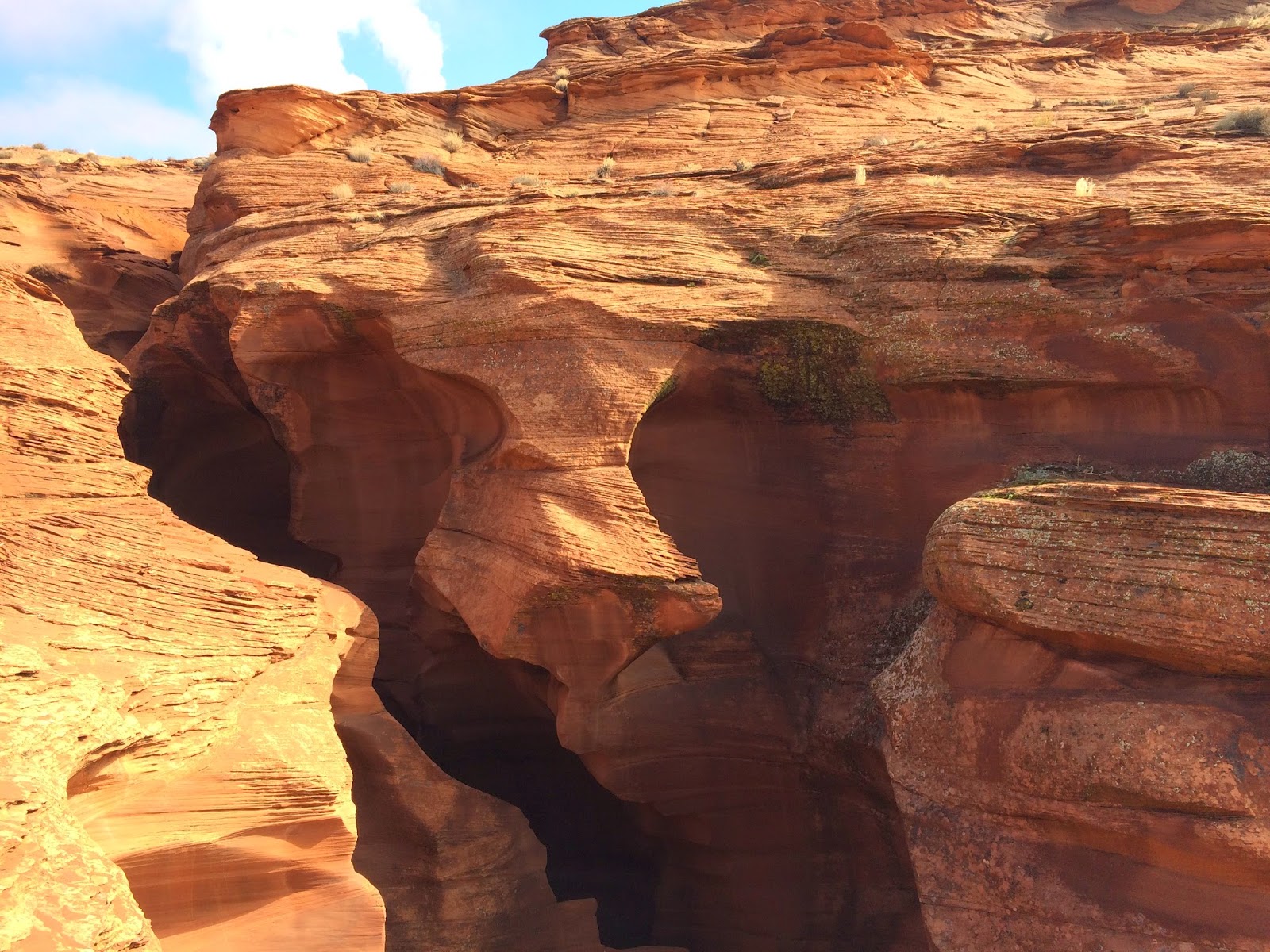
PHOTO MOMENT: Outside Antelope canyon
I can't get enough of the desert. This is outside (or on top of) Antelope canyon. You enter through the "slots" or giant cracks.
Thursday, February 19, 2015
PHOTO MOMENT: Arizona desert
While driving in Arizona looking for the slot canyons, I got a little lost. But with desert this gorgeous, being lost isn't all bad.
Monday, February 9, 2015
Starting the year with a Ragnar – from Miami to Key West
You would think living in Saudi Arabia would be enough of an adrenaline high, but apparently not. I have push myself when on vacation to which is why when I noticed that Ragnar Team U.S.A (Ultra Sexy Athletes) posted a desperate plea looking for a runner for the Key West Ragnar, I had to sign up.
I mean, how could I not? They needed a runner and I needed to run. Plus, a Ragnar in Florida meant I could hang out with my friend Kristen in Tampa the day before the race. And no, I had no idea who these people were before I met them on race day, but that’s the beauty of Ragnars. It’s a certain type of person that signs up for them, and those people are my people.
I admit, in any other situation flying 18 hours and showing up at a hotel room in Miami to spend the night with people I met on Facebook would not be something I would do. But when it's Ragnar people, it's perfectly acceptable.
I mean, it's like the equivalent of getting into a van to accept candy from a stranger…um wait a minute... Vans? Candy? Strangers? That sounds like Ragnar people too.
![]() |
| You know it's a Ragnar when every white van in the city has been rented |
AND THEN THERE WERE FOUR
The race began in Miami and was going to end in Key West. The six of us loaded up in Van 2 ready to go – all except one runner. He was smiling and trying to be positive, but he warned us that he hadn’t been feeling too good since the day before. He had severe stomach pain, but was hoping by the time it was his turn to run that it would be better.
Two hours later, it was his time and he wasn’t looking any better, but no problem. It was a short leg, we could double up and do it for him.
An hour later and he was looking bad. Really bad. While Van 1 did their runs, we quickly rushed him to the hospital for tests. Turns out he had burst his small intestine and wasn’t going anywhere anytime soon. His best friend, who was also a runner in our van, decided to stay behind with him in the hospital to make sure he was okay – because who wants to be in a strange city in the hospital by themselves?
But that meant we were down two runners. The four of us in the van would need to make up their legs if we were going to finish this Ragnar.
RAGNAR PEOPLE ROCK
What’s cool about Ragnar people is that when the going gets tough, the tough get running. It never even occurred to the team to quit the Ragnar. Even though none of us had trained enough to run the 30 to 35 miles we would now have to do each, we never complained. We looked at the legs, split them up and that was it.
We were going to run this thing even if it hurt.
And it did hurt. Running the extra miles during the second leg through the night wasn’t a big deal, but that third leg when we were running the doubles the next morning were not pretty.
The three of us (we let our driver off extra-running duty so he could be alert enough to get the van where it needed to go) were running pretty slow at the end. My hips were stiff from sweating and then sleeping in the van, and my toes hurt. Don’t know why, but they did.
But we did it. We completed a semi-ultra on the fly and we would do it again tomorrow!! Well, maybe not tomorrow, but in a week once my muscles stop cramping up.
Sunday, February 1, 2015
The beauty of Antelope Canyon
There are a few things I didn’t get to do when living in Arizona and visiting Antelope Canyon to check out the amazing wave shapes in the stone was one of them.
Antelope Canyon is located 4 hours from Phoenix or you can go from Las Vegas. It’s 4 hours from there as well. It’s quite a drive if you plan to go, see it and drive back in a day. I drove up to Flagstaff the night before and stayed in a cheap hotel to break up the trip, which I was glad I did as I got lost on the way and the 4-hour drive turned into 6 hours.
The lower and upper canyon are on Navajo land by Page, AZ and are located just outside the town. Surprisingly, it wasn't crowded at all, but they do recommend booking in advance just in case.
The canyon is what they call a slot canyon. You enter through these holes in the Earth and climb down a ladder to the bottom on the canyon. The canyon was formed by flash floods and water eroding the sandstone.
The effect is really quite memorizing. The photos I took were with my iPhone and were just the way the light played on the rock. I only did the lower canyon. This one has a ladder that you climb down so not recommended for people with knee troubles.
The upper canyon is also beautiful and doesn’t require any climbing. Both canyons don’t require a lot of cardio. There were a couple young kids on my tour and they had no problem doing the tour. The walking tour of the canyon takes about an hour.
You can only go through the canyon on a tour, but the tours are inexpensive. It was $28. I went with Ken's Tours ( http://lowerantelope.com/?page_id=51)
Tuesday, January 6, 2015
Crossing Doha off the bucket list
Doha is one of the Middle Eastern cities I've been wanting to visit since living in Saudi. Not only will it be the city for the 2022 World Cup, but it’s got some pretty amazing buildings and an interesting history. Because of this I wanted to see it before it got wrapped up in the World Cup hype.
Doha has nearly 800,000 people and is the capital of Qatar. The majority of the people living there are expats and feels very similar to Dubai -- but it's not quite as over the top as Dubai.
In the early days, the city’s economy was based on fishing and pearl harvesting. You can still visit their pearl village while there. Now their economy comes from the oil industry and a number of major oil companies have their headquarters in the city.
I didn’t get see as much as I wanted to as I went there on my way back from Haiti and got sick on the plane. But I did walk the corniche and checked out a few of the buildings.
I also got to see their W hotel, which is rumored to have an amazing happy hour and night life. Unfortunately, my stomach would not let me partake in any of that fun. I actually threw up in the lobby and was so miserable feeling, I wasn't even embarrassed - a rare thing. The resort staff felt so bad for me they had chicken soup brought to my room - such a nice thing to do.
5 things to do in Doha:
1. Shop the traditional way in their local souks
2. Walk their corniche and see the oyster monument
3. Take a ride on a Dhow – a traditional fishing boat
4. Listen to jazz at the Lincoln Center
5. Go on a desert adventure to see the bedouin tents and take in where the sand dunes meet the sea
![]() |
| The W sent me complimentary chicken soup. How sweet is that? |
Thursday, January 1, 2015
Haiti Day 5: Final day of the mission
What is interesting about Haiti is in every location, the patients we met were distinctively unique. Some locations earlier in the week were severely malnourished, some had more STDs and infections, and some were healthier, but had run out of the medications and needed our help to keep them healthy.
Today’s clinic was no exception. We saw many cases today that we hadn’t come across before in our clinic such as an infant that had been born with its fingers fused together, a child with Down’s syndrome and a 5-year-old with severe scoliosis.
One of our first patients was a 33-year-old woman with a strange 4-inch indentation on her upper thigh. It looked like a large abscess that was healing. She told us 8 months ago, the area had become swollen but she didn’t know why. Puss started to ooze out of it so she went to the hospital to have it drained. When we saw her today, it was obvious it was still there, and she said it hurt. The good news is that it was no longer swollen and looked like it was on its was to healing. There was nothing more we could do for her except confirm that it was no longer infected.
Today’s clinic was no exception. We saw many cases today that we hadn’t come across before in our clinic such as an infant that had been born with its fingers fused together, a child with Down’s syndrome and a 5-year-old with severe scoliosis.
One of our first patients was a 33-year-old woman with a strange 4-inch indentation on her upper thigh. It looked like a large abscess that was healing. She told us 8 months ago, the area had become swollen but she didn’t know why. Puss started to ooze out of it so she went to the hospital to have it drained. When we saw her today, it was obvious it was still there, and she said it hurt. The good news is that it was no longer swollen and looked like it was on its was to healing. There was nothing more we could do for her except confirm that it was no longer infected.
In Haiti, giving birth is still dangerous for the mother and the baby. Mothers don’t always have access to a hospital and sometimes give birth at home. And others die in the hospital or if there are complications, both the baby and the mother may not make it. We came across a couple of these situations today. One was a little 6-month-old baby, whose mother had died during childbirth so the baby’s aunt was taking care of it. The baby was underweight for its age and hadn’t been eating.
“The baby didn’t have any strength in its legs which is not normal for a 6-month-old,” our doctor said, when checking out the infant. "We fed it using a syringe, and because the aunt didn’t have a bottle, we showed her how to make the formula using boiled water and how to feed it with a syringe to help it thrive."
Another baby that stole our hearts was a 7 month old who was so malnourished that it looked like it was only a month old. It weighed 3 kgs (just over 6.5 pounds).
“Mom died when the baby was born and they had been feeding it cow’s milk once a day,” said nurse Jodie.
When the mother died, Grandma – who was only 29 years old and had a 3-year-old of her own at home – tried to breastfeed the baby until her milk dried up. We syringe fed the infant until it was full, and then gave the family formula for the baby with feeding instructions. “I was not going to let him leave here without eating,” the nurse said.
Dr. Erica also had a unique case. A 56-year-old man came in with a swollen nipple. He said it started 7 months ago, and he didn’t know what had caused the large abscess.
“Normally, I would have used scissors to open up the area and drain it all at once, but we don’t have a strong enough pain medicine here. I tried, but he couldn’t tolerate the pain. So I had to try to drain it the best I could with what we had,” Erica said.
After draining the area as best she could to alleviate the pressure around the nipple, she prescribed something for the man’s pain and to help stop infection from occurring.
Another case that came in was a man with a swollen knee. He was 60 and said he fell two years ago and it’s been swollen ever since. In fact, his whole lower leg from the knee to the foot appeared swollen and he had no feeling in the bottom of his foot.
“At first I wanted to drain the knee, but even if we had the tools, it would just become swollen again without proper follow up care,” said Dr. Erica.
It’s frustrating at times like this, but it’s one of the things the doctors and nurses on the IMR team have to think about. Many of the patients won’t have access to follow up care so the treatments they do and medications they prescribe need to take that into consideration.
Another thing that adds an extra challenge to our providers is many of the women aren’t sure if they are pregnant or not. We ran out of pregnancy tests the day before, so we needed to rely on the patient’s knowledge of their own body before prescribing things. In Haiti, many women don’t know they are pregnant until they start showing, which is usually around the second or third month.
“One of the translators told me it’s common for Haitian babies to be born at 7 months. In reality, it has been the full 9 months. They just didn’t realized they were pregnant until they were two months along,” said Nurse Natalie.
But amongst the sad moments, there were times of joy. “For the first time today, I got hear a fetal heartbeat. It was so sweet, I cried,” said one of the nursing students.
It was a long, hard week, but for those we helped, it was worth it.
Related posts:
Haiti Day 1: Start of Medical Mission Trip
Haiti Day 2: Transforming a school to a medical clinic
Haiti Day 3: Venturing out to help in rural areas
Haiti Day 4: Sweating it out on New Year's Eve on a Mission Trip
Haiti Day 5: Final day of the International Medical Relief mission
Haiti: The boy with the foot
Related posts:
Haiti Day 1: Start of Medical Mission Trip
Haiti Day 2: Transforming a school to a medical clinic
Haiti Day 3: Venturing out to help in rural areas
Haiti Day 4: Sweating it out on New Year's Eve on a Mission Trip
Haiti Day 5: Final day of the International Medical Relief mission
Haiti: The boy with the foot
Wednesday, December 31, 2014
Haiti Day 4: Sweating it out on New Year's Eve
It's Day 4 of the Haiti Medical Mission Trip with International Medical Relief and today we were at a community that looked a bit like an enclosed compound. We drove through a high gate and into a walled in area where about a dozen structures were set up. Some of them were metal silos with a bunch of bunk beds inside and others were made out of concrete cinder blocks with crushed stones for a floor and nothing else inside.
Many of our patients came in with the same symptoms we had seen at the other locations: UTIs, STDs, dehydration and worms. But there were some interesting cases. We saw a woman who had cataracts in both eyes and was so anemic her teeth were bleeding. She looked like she was an older woman (like in her 60s) so we were surprised to learn she was only 40. Unlike in the U.S., getting surgery to remove it from a person’s eyes is rare in Haiti.
We set up the pharmacy in one of the metal silos, while triage and community education shared one of the cinder block homes. Well- and sick-care were set up under a tarp outside. At 7:30 in the morning it was already hot, so we needed the shade we could get.
Many of our patients came in with the same symptoms we had seen at the other locations: UTIs, STDs, dehydration and worms. But there were some interesting cases. We saw a woman who had cataracts in both eyes and was so anemic her teeth were bleeding. She looked like she was an older woman (like in her 60s) so we were surprised to learn she was only 40. Unlike in the U.S., getting surgery to remove it from a person’s eyes is rare in Haiti.
“It’s sad. She’s so young and already the cataracts has made her nearly blind,” said med student Caitlin.
We are always learning something new on this trip -- even those who have been in the medical field for a while. Nurse Patti took the lead on what we called our mini clinic. Our location was by an orphanage. We had 56 children and adults come over that needed treatment. She sat them all down in a room and with the help of two other mission volunteers, they treated them all and made sure they all got worm pills.
But with the good times, there are always those moments that bring us back to reality and the importance being there. Nurse Amy had a infant who came in with its aunt. The poor baby was so dehydrated, the soft spot around its head was sunken in.
“It was crying and was so hungry, yet there were no tears,” said Amy. “We started giving it some water and now it has tears. Its also so much more happy and content.”
Another first was this six-year-old girl who came in complaining about ear pain. We took a look inside her ear and saw she had a fly in there. Judging by the amount of wax that had built up around it, the fly had been in there for a while.
“At first we tried to get it out with a tool, but it was too deep. We had to use a syringe,” said nursing student Mackie. “The girl was so scared. She was flailing and trying to get away from us, but eventually we were able to calm her AND get the fly out.”
We set a new record that day by seeing 329 patients plus the 56 from the orphanage. Already, we are beginning to run out of medications to treat many of the fungal infections and other common issues the people had. We also ran out of Tums. We can’t believe how many we have given out, so if you ever come to Haiti on a mission, bring Tums. Lots and lots of Tums.
Related posts:
Haiti Day 1: Start of Medical Mission Trip
Haiti Day 2: Transforming a school to a medical clinic
Haiti Day 3: Venturing out to help in rural areas
Haiti Day 4: Sweating it out on New Year's Eve on a Mission Trip
Haiti Day 5: Final day of the International Medical Relief mission
Haiti: The boy with the foot
We set a new record that day by seeing 329 patients plus the 56 from the orphanage. Already, we are beginning to run out of medications to treat many of the fungal infections and other common issues the people had. We also ran out of Tums. We can’t believe how many we have given out, so if you ever come to Haiti on a mission, bring Tums. Lots and lots of Tums.
Related posts:
Haiti Day 1: Start of Medical Mission Trip
Haiti Day 2: Transforming a school to a medical clinic
Haiti Day 3: Venturing out to help in rural areas
Haiti Day 4: Sweating it out on New Year's Eve on a Mission Trip
Haiti Day 5: Final day of the International Medical Relief mission
Haiti: The boy with the foot
Subscribe to:
Posts (Atom)